Sustainable Style Starts in Your Closet: How a Digital Wardrobe App Helps You Buy Less and Wear More
Here's the paradox no one talks about: we own more clothes than any generation in human history, yet most of us feel like we have nothing to wear. The average American now buys 60% more clothing than they did just 15 years ago — and keeps each piece for half as long. Meanwhile, the fashion industry pumps out roughly 10% of global carbon emissions, more than international aviation and shipping combined. The clothes piling up in our closets aren't just a personal organization problem. They're an environmental one.
And here's what's even more uncomfortable: approximately 35% of fast fashion items are never worn at all. Tags still attached. Bags never unpacked. Impulse buys that sounded good in the store, or looked irresistible in a social media ad, now living in permanent exile at the back of the closet.
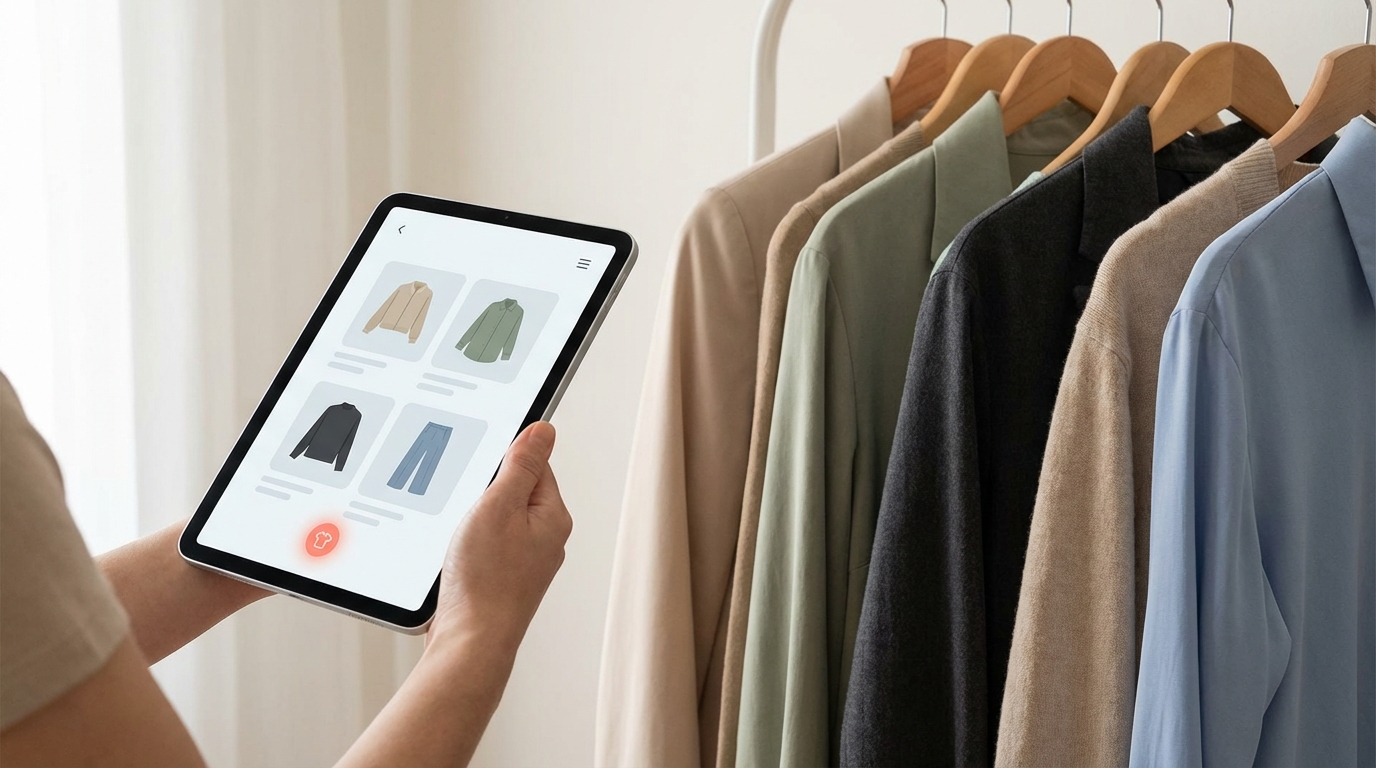
The good news? You don't have to choose between loving fashion and caring about the planet. The shift starts with seeing what you actually own — and that's exactly where a digital wardrobe app comes in.
The Fast Fashion Feedback Loop (And Why You're Probably Stuck In It)
Fast fashion is engineered to feel affordable. A $12 dress, a $15 top, a $9 pair of shorts — individually, none of these feel like a big deal. But the true cost of each item is almost never visible at checkout.
Consider what "cheap" clothing actually requires: water-intensive cotton farming, synthetic dye processing that poisons waterways, factory conditions that rely on suppressed wages, and a supply chain that ships garments across multiple continents before they reach your hands. That $12 dress may have cost the planet far more than its price tag suggests.
And then there's the wearability math. If you buy a $12 dress and wear it twice before it pills, fades, or falls out of favor, your cost-per-wear is $6. If you invest $120 in a well-made linen dress and wear it 60 times over three years, your cost-per-wear drops to $2 — and the environmental footprint per wear shrinks proportionally.
Cost-per-wear is one of the most practical frameworks for sustainable thinking. It reframes quality as value, and disposability as waste. But it only works if you know what you already own and how often you're actually reaching for it.
Pro Tip: Before your next shopping trip, spend 10 minutes browsing your digital closet instead. Chances are you'll find three things you forgot you owned that fit the same need as what you were about to buy.
The True Cost of Your Wardrobe (It's Not Just Money)
Let's look at some numbers that don't usually make it onto the hangtag.
The fashion industry generates 92 million tonnes of textile waste per year — enough to fill a garbage truck every second. The average garment is worn just 7 to 10 times before it's discarded. Synthetic fabrics like polyester and nylon, which now make up the majority of fast fashion items, shed microplastics with every wash — an estimated 500,000 tonnes of microfibers enter the ocean annually from laundry alone.
On the personal finance side: the average American spends around $1,800 per year on clothing. Studies suggest that somewhere between 50% and 80% of that money goes toward items that get worn fewer than five times. That's potentially $900 to $1,440 in annual waste — per person.
The environmental math is just as stark. Producing a single cotton t-shirt uses roughly 2,700 liters of water — the equivalent of what one person drinks over two and a half years. A pair of jeans requires around 7,000 liters.
None of this is meant to make fashion feel guilt-ridden and joyless. Clothes are creative, expressive, and genuinely fun. The goal isn't to stop buying — it's to buy better, and to actually use what you have. Two things that become dramatically easier once you have visibility into your wardrobe.
The Closet Blindspot Problem
Most of us suffer from a version of the same issue: we can't see our whole wardrobe at once, so we default to a small rotation of visible, easy-to-grab items. Studies confirm this — people regularly wear only about 20% of their clothing 80% of the time. The rest sits in purgatory: not donated, not worn, just taking up space.
This blindspot is the engine of overconsumption. We buy a new black blazer because we forgot we already had one. We grab a new pair of white sneakers because we can't find the ones buried in the back of the closet. We purchase another striped t-shirt because, honestly, we just weren't sure if we had one that still fit well.
A digital wardrobe app eliminates this blindspot entirely.
How a Digital Wardrobe App Changes Your Shopping Behavior
The behavioral change that comes from wardrobe management isn't about willpower or restriction. It's about information. When you can actually see everything you own — organized, searchable, and categorized — your relationship with shopping fundamentally shifts.
Visibility Stops Duplicate Purchases
Once your wardrobe is catalogued digitally, you'll never again stand in a store wondering if you have something similar at home. A quick search in your app answers it instantly. That's a direct, friction-free brake on impulse purchases.
Research into consumer behavior consistently shows that purchase regret — buying something only to discover you already own a near-identical version — is one of the most common drivers of donation and waste. Wardrobe visibility cuts this pattern off at the source.
Outfit Planning Kills Impulse Buying
The other major driver of overconsumption is the "I don't have anything to wear with this" trap. You own the skirt, but need a top. You have the shoes, but nothing that goes with them. So you buy more.
Outfit planning tools in a digital closet app let you virtually assemble looks from what you own before you ever set foot in a store. When you can see that your existing wardrobe already gives you 30+ outfit combinations, that FOMO-driven shopping trip loses its urgency.
Better outfit planning also means fewer returns. Online shopping return rates hover around 20-30%, with clothing having some of the highest rates of any retail category. Shipping returns has a massive carbon footprint — estimates suggest that returns in the US alone generate over 5 billion pounds of landfill waste annually. Virtual try-on technology, paired with outfit planning, dramatically reduces the odds of a return by helping you visualize fit and styling before purchasing.
Pro Tip: Use your digital wardrobe's outfit history feature to find your "stranded" items — pieces you own but have never styled into a complete outfit. Treat it as a creative challenge before shopping for anything new.
Cost-Per-Wear Tracking Makes You a Smarter Investor
A wardrobe app that tracks how often you reach for each item does something powerful: it shows you which pieces are genuinely earning their place in your closet, and which are dead weight.
Over time, this data changes how you shop. You stop chasing low price tags and start asking better questions: Will I actually wear this 30 times? Does it work with things I already own? Is the construction quality good enough to last? These aren't restrictive questions — they're the questions of someone who takes their own taste seriously.
The result is a closet with less volume and higher quality — which is both better for your bank account and better for the planet.
Sustainable Wardrobe Scorecard
Be honest with yourself on each of these. The goal isn't to feel bad — it's to find where the biggest wins are hiding.
- Do you know how many items you own? (Most people are off by 40-60%)
- Can you name 5 items you haven't worn in the past 6 months?
- Do you check what you already own before shopping for something new?
- Do you know the cost-per-wear of your most-used items vs. your least-used?
- Have you ever bought a near-duplicate of something you already owned?
- Do you shop with a specific gap in mind, or browse until something catches your eye?
- Have you returned an online clothing purchase in the past 3 months?
- Do you plan outfits in advance, or decide what to wear while standing at the closet?
If you answered "no" to most of these, you're not alone — and the fix isn't a personality overhaul. It's better tools.
Common Questions
"Isn't cataloguing my whole wardrobe incredibly time-consuming?"
It sounds more daunting than it is. Most people can photograph and upload their wardrobe in a couple of focused sessions — and apps with AI photo recognition can auto-categorize items as you add them, cutting the process down significantly. Think of it as a one-time investment that pays off every single time you get dressed or open a shopping app.
"I already know what's in my closet. Do I really need an app?"
Most people think they know their wardrobe better than they actually do. Until it's catalogued digitally, it's easy to overestimate how often you wear certain items, forget about things in storage or at the back of a drawer, and miss the 20-30 outfit combinations hiding in what you already own. The act of cataloguing alone tends to surface forgotten gems.
"How does a digital wardrobe app actually reduce my environmental impact?"
The most direct mechanisms are: fewer duplicate purchases (less production demand), fewer returns (less shipping waste), longer garment lifespans through better usage, and smarter investment in higher-quality, lower-turnover pieces. The app doesn't make these choices for you — it gives you the information to make them yourself.
"What about the clothes I already own but never wear? Should I donate everything?"
Donating thoughtfully is better than holding onto items indefinitely. But before you purge, try the styling challenge first — pull out your "stranded" items and use your app's outfit planning tool to find combinations you haven't tried. Sometimes an unworn piece just needed to be paired with the right thing. If it genuinely doesn't work and you'll never reach for it, donating to a local thrift shop or textile recycling program is a far better outcome than landfill.
"Is sustainable fashion just for people who can afford to buy expensive clothes?"
Not at all. Sustainable fashion is fundamentally about reducing consumption and extending garment life — both of which save money. Thrifting, clothes swapping, styling what you own more creatively, and avoiding unnecessary purchases are all accessible regardless of budget. A digital wardrobe app is a tool for exactly this kind of intentional, cost-conscious approach to style.
Real User Success Stories
Priya, sustainability advocate and grad student: "I used to do a mini haul every month — not huge, but constant. After six months using a digital closet app, I realized I had 14 striped tops. Fourteen. Once I could see everything laid out, the whole habit just... stopped making sense. I've barely bought anything new in eight months and somehow feel like I have more to wear."
Marcus, freelance photographer: "I was skeptical that an app could change how I shop, but the cost-per-wear tracking genuinely shifted something. I saw that my 'expensive' leather jacket had a cost-per-wear of $0.80 after two years. Some $30 fast fashion pieces were at $15 per wear because I'd only put them on once. The numbers told the story better than any sustainability lecture ever could."
Zoe, remote worker and slow fashion convert: "I started using the app mostly for outfit planning — I was bored with my clothes even though I had a full closet. The virtual try-on feature helped me discover combinations I'd never have thought to try. My shopping has dropped by probably 70%, and I actually enjoy getting dressed now because I feel like I'm working with a curated wardrobe instead of a chaotic pile."
Conclusion: Less Closet Chaos, More Conscious Style
Sustainable fashion doesn't require a complete lifestyle overhaul. It starts with the clothes already hanging in your closet — the ones you're not seeing, not wearing, and not getting value from.
A digital wardrobe app gives you the visibility to break the overconsumption cycle: fewer blind spots, smarter shopping decisions, and a closet that actually reflects your taste instead of your impulses.
- ✅ Know exactly what you own and stop buying near-duplicates
- ✅ Plan outfits in advance and shop only for genuine gaps
- ✅ Track cost-per-wear to invest in quality over quantity
- ✅ Reduce returns and the carbon footprint that comes with them
- ✅ Discover the outfits already hiding in your existing wardrobe
Start wearing more of what you own — build your free digital wardrobe with Cufflink AI.
Ready to Build a Sustainable Wardrobe?
Get started with CuffLinkAI for free today:
Start Your Free Digital Wardrobe →
What you'll get:
- ✨ AI-powered wardrobe cataloguing that auto-categorizes your clothing
- 👗 Outfit planning tools to unlock combinations you've never tried
- 🤖 Virtual try-on so you can shop smarter and return less
- ✈️ Packing and travel outfit planning for every trip
- 📱 A clean, searchable digital closet available on any device
Your wardrobe already has more to offer than you think. Let's find it.